
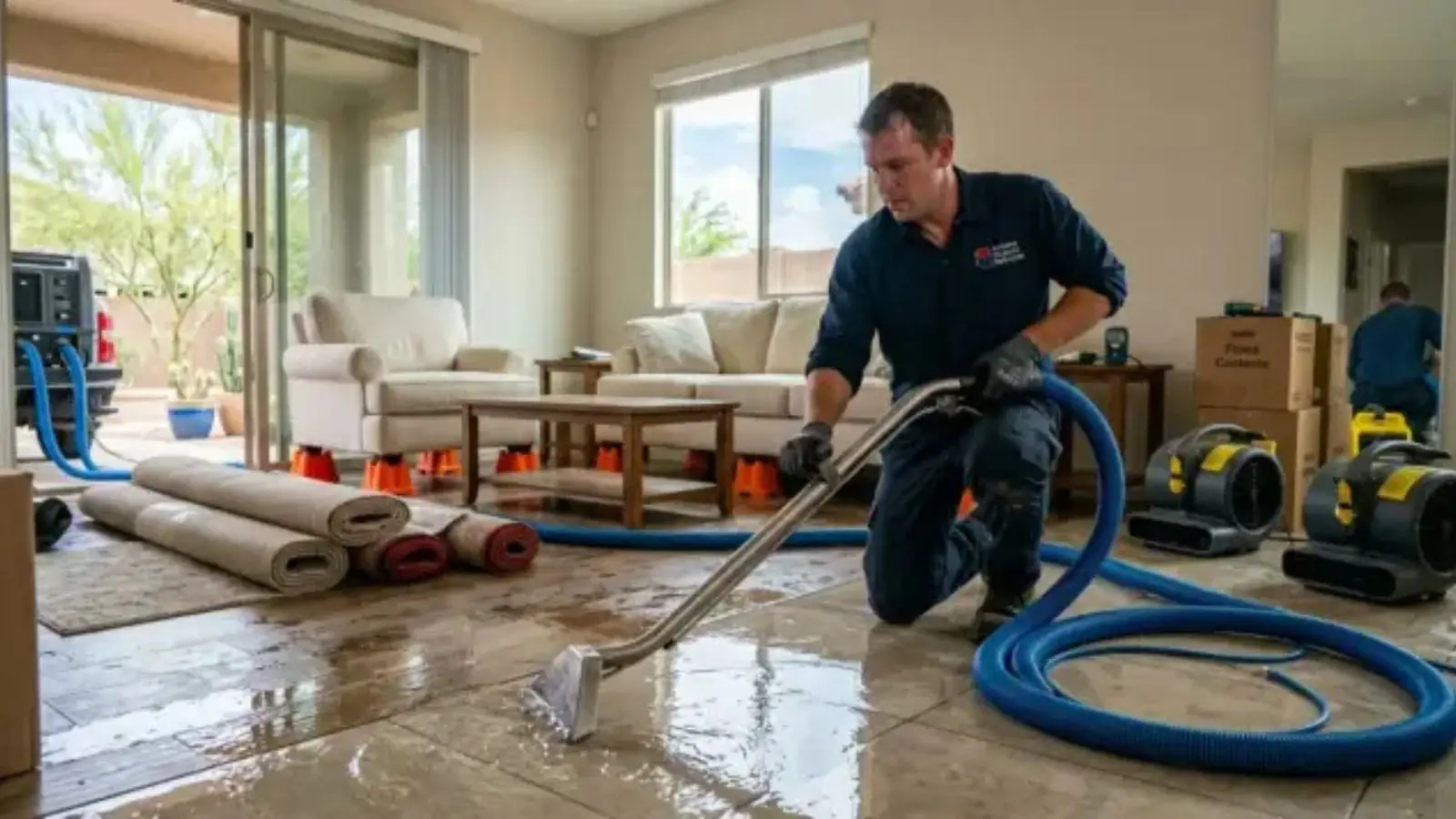
Water Damage Restoration in San Pedro, CA
Water damage restoration means stopping the source, removing standing water, drying wet structure with measured equipment and rebuilding what cannot be saved. Our 24/7 emergency line sends crews across San Pedro and nearby towns.
- Licensed and insured
- Scope and price explained before work starts
- Serving San Pedro and nearby towns
Coverage at a glance
Water on the floor right now?
The emergency line is answered around the clock, every day of the year.
Emergency water damage help for San Pedro homes and businesses
Water damage in San Pedro rarely waits for a convenient hour. A supply line lets go under a kitchen sink after midnight, a roof leak shows up on a bedroom ceiling during a January storm, or a water heater fails in a garage on a Sunday. The emergency line is open 24/7, and the person who answers can start sorting out what happened and what to do next.
San Pedro sits on a peninsula with the Pacific to the south and the harbor to the east, and the area gets roughly 14 inches of rain a year, most of it from January through March. That is modest compared with other parts of the country, but a long dry summer followed by a heavy winter storm is exactly when old roof flashing, clogged gutters and aging supply lines give out.
Many losses start inside a wall or ceiling long before anyone sees a stain.
The plan after the call is simple. Stop the source, document what you see, and get measured drying started before wet drywall and padding turn into a mold problem. The sections below explain how each service fits, what shapes the scope and price, and what to do while you wait.
Water damage services in San Pedro
Every job begins with a different question, so the work is split by what the situation needs. Pick the page that matches what you are looking at, or call and describe it. The person on the line will point you to the right starting place.
Water damage repair
Rebuilding after drying: drywall, insulation, flooring, paint and cabinets. Ceiling and wall damage from roof and plumbing leaks is covered in detail.
See repair workEmergency water removal
Standing water pumped and extracted right now, from burst pipes, failed hoses and active leaks, with safety steps for wet electrical areas.
See water extractionFlood damage restoration
Storm, groundwater and drain backup losses, including basements and Category 2 or 3 water that needs careful handling.
See flood restorationWater mitigation
The first 24 to 72 hours: shutting off the source, moisture mapping and setting drying equipment before damage spreads.
See mitigationWater damage cleanup
Removing wet debris and ruined materials, then cleaning, sanitizing and deodorizing the affected rooms.
See cleanupMold remediation
Containment and removal where moisture has already fed mold growth, following the S520 standard for mold work.
See mold workWhat to do while you wait for the crew
These steps protect you and keep the loss from growing. None of them replace the call, and none of them are worth a risk. If a step is not safe, skip it and wait.
Stop the source
Close the shutoff valve at the fixture, or the main water valve for the house if you cannot find the fixture valve. If water is coming from the roof, move belongings out of the drip path and catch what you can in a bucket.
Think about power first
Turn off power to wet areas only if you can reach the panel while standing on dry ground. If water is near outlets, a panel or an appliance, stay out and call the utility or 911 before you call us.
Lift what you can
Move small furniture, rugs and electronics to dry rooms. Put foil or wood blocks under furniture legs on wet carpet so finishes do not stain.
Keep people and pets out
Standing water can hide electrical hazards, and water from a drain or toilet is contaminated. Keep children and animals away until the crew has looked at it.
Electrical or gas risk comes first
If you smell gas, see sparks, or water is touching a panel, leave the area and call 911 or the utility before you call the restoration line. The crew can wait. Your safety cannot.
How a San Pedro water loss is handled, step by step
Call the 24/7 line
Describe where the water came from, how long it has run and what is wet. Photos taken on your phone help.
Assessment and scope
Moisture meters and thermal imaging show where water traveled. You get the scope and the price explained before work starts.
Mitigation and drying
Extraction units remove standing water, then air movers and dehumidifiers dry the structure until readings reach dry standards.
Cleanup and repair
Ruined materials come out, surfaces are cleaned and sanitized, and repair brings the room back to a finished state.
Drying is measured, not guessed. Crews set air movers to push air across wet surfaces and low-grain refrigerant (LGR) dehumidifiers to pull moisture out of the air, then take moisture readings every day. Ordinary losses often need around three to five days of drying, but a soaked subfloor or a wall cavity full of insulation can take longer. The readings, not the calendar, decide when the equipment leaves.
The industry reference for this work is ANSI/IICRC S500, the published standard for professional water damage restoration. Any company you hire should be willing to tell you whether its crews work to it, and you are free to ask us the same thing when you call.
Which kind of water is it? A quick decision table
Water is sorted into three categories, and the category decides what can be dried in place and what has to be removed. A burst supply line is not the same job as a backed-up drain, even when both leave an inch of water on the floor.
| Category | Typical source | What it usually means for materials |
|---|---|---|
| Category 1 | Broken supply line, failed water heater, roof leak caught early | Often dried in place if acted on quickly, because the water starts clean. |
| Category 2 | Washing machine or dishwasher overflow, aquarium, sump pump failure | Porous materials such as carpet padding are commonly removed, and hard surfaces are cleaned and dried. |
| Category 3 | Sewage backup, rising floodwater, long-standing standing water | Contaminated. Porous materials are removed, and the area is cleaned and sanitized before any repair. |
Time matters because water changes category as it sits. Clean water that stays in carpet and drywall for a few days can pick up bacteria and mold, which is why the first call should not wait until morning.
What shapes the scope and price of a water damage job
Nobody can give an honest number for a wet house over the phone. What a good company can do is explain the factors, tell you how the number will be built, and put the scope in writing before work starts. These are the five that move a job the most.
| Factor | What changes | Why it matters |
|---|---|---|
| Water category | Clean, gray or contaminated | Contaminated water means more removal and more cleaning steps. |
| Affected area | Square footage and number of rooms | More wet surface needs more air movers and more dehumidifier capacity. |
| Materials involved | Hardwood, carpet, drywall, plaster, tile or cabinets | Dense materials hold water longer and some cannot be saved. |
| Drying days and equipment | How long the equipment runs | Moisture readings decide the length, not a fixed schedule. |
| Rebuild scope | Drywall, paint, flooring and trim | Repair is priced separately from mitigation and depends on finishes. |
Want your real number? Describe the damage on the phone and ask how the scope and price will be explained.
☎ Call (424) 550-5662Water damage and your insurance claim
Sudden and accidental water damage, such as a burst pipe, is often covered by a homeowners policy. Slow leaks and neglected maintenance often are not, and flood damage is usually excluded and needs separate flood coverage. Read your policy or ask your insurer which applies to you, because the wording differs from one policy to the next.
What helps your claim is a clear record. Photograph and film the damage before anything is moved, write down what was wet and what it was worth, keep receipts for emergency steps you take, and hold on to damaged materials until your adjuster says otherwise.
We provide moisture readings and a written scope of work that you can hand to your insurer. We do not promise that a claim will be approved, and we do not set what a carrier pays.
Water damage across San Pedro, from the bluffs to the harbor
San Pedro has a long record of water finding its way where it should not. At Sunken City near Point Fermin Park, a 1929 landslide carried about 40,000 square feet of land into the Pacific. The first damage reports that January came when a water line broke beneath a hotel on Paseo Del Mar, and the slide itself was blamed on waves undercutting the cliff and water soaking into a clay layer.
The lesson for a homeowner on the bluffs is practical: an unnoticed leak is worth finding early, because water that soaks into a house or the ground around it rarely stays put.
Gaffey Street is the main north-south street and the place where Interstate 110 begins, so when you call, naming the nearest cross street to Gaffey helps the dispatcher place you. Homes near Cabrillo Beach and the Cabrillo Marine Aquarium sit in the damp coastal zone, where indoor humidity stays high after a leak, so drying is checked with meter readings rather than by feel.
Across the Vincent Thomas Bridge, commercial and port-area buildings on Terminal Island and near the Port of Los Angeles usually have larger floor areas, and a bigger building needs more equipment and a written drying plan.
Tenants in Fort MacArthur housing, apartments near downtown San Pedro and condos along the bluffs should report a leak to their property manager in writing right away, then call the line so the water is dealt with the same day.
Nearby towns and ZIP codes we cover
The home base is San Pedro, including ZIP codes 90731 and 90732. Crews also work in nearby towns, and each has its own page with local details: Wilmington to the east, Harbor City to the north, Rancho Palos Verdes and Lomita to the west, and Torrance beyond them.
Nearby ZIP codes include 90744 in Wilmington, 90710 in Harbor City, 90275 in Rancho Palos Verdes, 90717 in Lomita and 90501 through 90505 in Torrance. If you are not sure whether your address is covered, call the 24/7 line and give the street name.
When water sits too long, mold follows
Mold needs moisture, and a wet wall or carpet that stays damp for more than a day or two can start to grow it. If you can see or smell mold after a leak, the water source must be fixed first, then the area is contained and cleaned following the ANSI/IICRC S520 standard for mold remediation.
Questions about how mold affects health belong with a physician. For the removal side, see the mold remediation page, and for stopping the damage early, see water mitigation.
Questions people ask before they call
Do you handle water damage emergencies at night or on weekends in San Pedro?
Yes. The emergency line is answered 24/7, including nights, weekends and holidays. Same-day response is offered when available, and the person on the line will tell you what to do while the crew is on the way.
What should I do before the crew arrives?
Stop the source if you can do it safely, keep away from wet electrical equipment, lift valuables off wet floors and take photos. Skip any step that is not safe and wait for help.
Can someone look at the damage and explain the scope and price?
Yes. An assessment comes first, using moisture meters and thermal imaging, and the scope and price are explained before work starts. If you only want someone to look at it, say so when you call.
How long does drying take, and what equipment is used?
Crews use extraction units, air movers, LGR dehumidifiers and moisture meters. Many ordinary losses need roughly three to five days, and daily readings decide when drying is done. The equipment is part of the drying work.
Does insurance cover water damage?
Often, when the damage is sudden and accidental. Gradual leaks are often excluded and flood usually needs separate flood coverage. Check your policy or ask your insurer, and keep photos and receipts. For a large loss, ask for the written scope and moisture records early.
Is water damage restoration the same as waterproofing?
No. Restoration dries and repairs damage that has already happened. If water keeps entering through a foundation or a wall, the entry point needs a waterproofing or drainage contractor. We will tell you honestly when that is the real problem.
Do you serve ZIP codes 90731 and 90732?
Yes. Both San Pedro ZIP codes are covered, along with the nearby towns of Wilmington, Harbor City, Rancho Palos Verdes, Lomita and Torrance.
Water is spreading while you read this
Shut off the water if you safely can, then call the 24/7 line and describe what you see.
☎ Call (424) 550-5662